what are the four parts to every function?
Lesson 5: Functions
/en/excelformulas/relative-and-absolute-jail cell-references/content/
Introduction
A office is a predefined formula that performs calculations using specific values in a particular social club. All spreadsheet programs include common functions that can be used for quickly finding the sum, average, count, maximum value, and minimum value for a range of cells. In order to use functions correctly, you'll need to sympathize the unlike parts of a function and how to create arguments to calculate values and cell references.
Watch the video below to learn more than about using functions in Excel.
The parts of a office
In order to work correctly, a part must be written a specific way, which is chosen the syntax. The basic syntax for a office is an equals sign (=), the part proper noun (SUM, for example), and 1 or more arguments. Arguments contain the data you want to calculate. The function in the example beneath would add together the values of the cell range A1:A20.

Working with arguments
Arguments can refer to both individual cells and prison cell ranges and must be enclosed within parentheses. You tin can include one argument or multiple arguments, depending on the syntax required for the role.
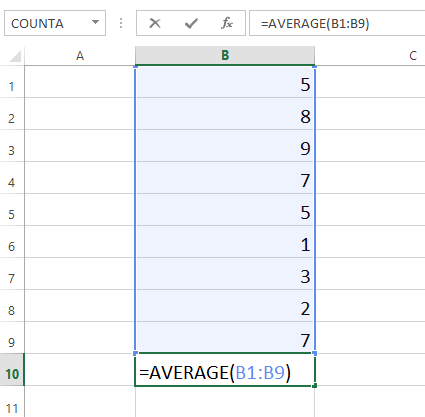
For example, the role =Average(B1:B9) would calculate the boilerplate of the values in the prison cell range B1:B9. This function contains but ane argument.
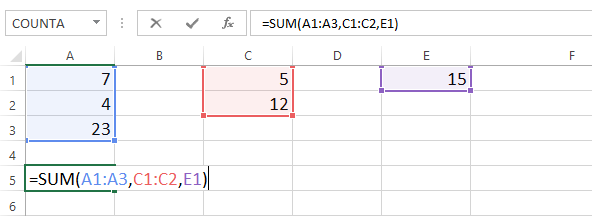
Multiple arguments must be separated by a comma. For example, the function =SUM(A1:A3, C1:C2, E2) will add the values of all cells in the three arguments.
Using functions
There are a multifariousness of functions. Here are some of the well-nigh mutual functions you lot'll use:
- SUM: This office adds all the values of the cells in the argument.
- Boilerplate: This office determines the average of the values included in the statement. It calculates the sum of the cells and then divides that value by the number of cells in the argument.
- COUNT: This function counts the number of cells with numerical data in the argument. This function is useful for quickly counting items in a cell range.
- MAX: This function determines the highest jail cell value included in the argument.
- MIN: This part determines the lowest prison cell value included in the argument.
To use a function:
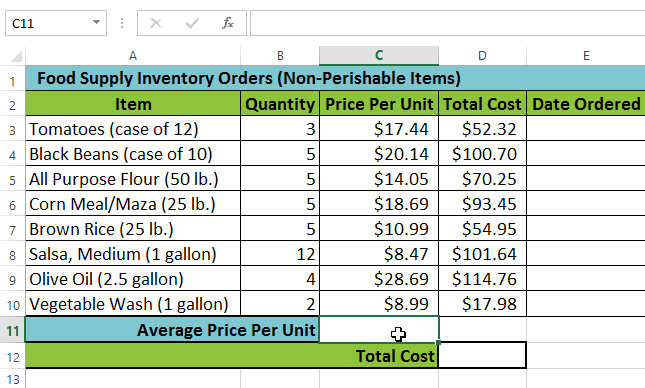
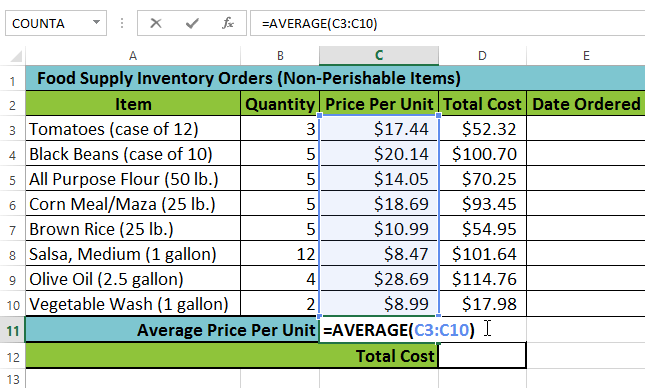
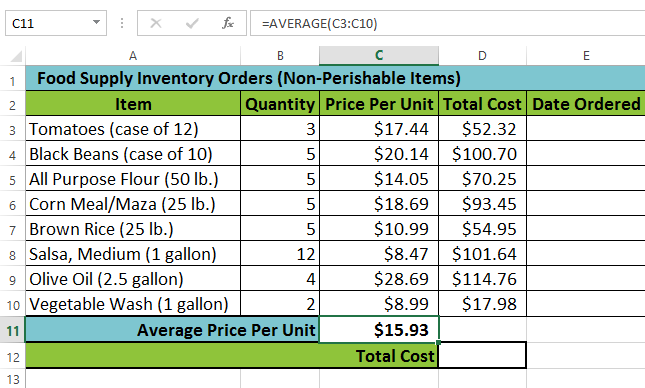
In our example below, we'll use a basic part to summate the average toll per unit for a list of recently ordered items using the Boilerplate function.
- Select the cell that will contain the function. In our example, we'll select cell C11.
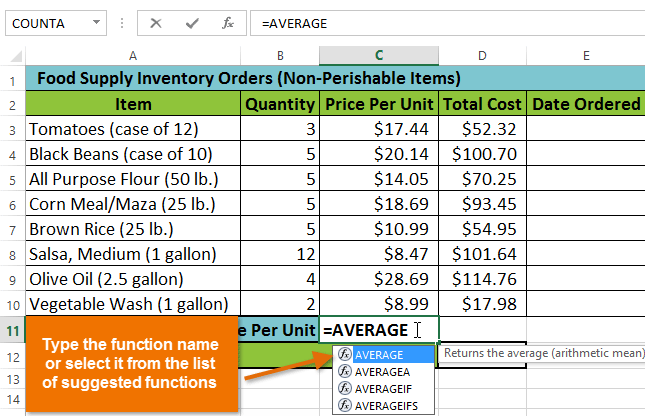
- Type the equals sign (=) and enter the desired function name. In our example, we'll type =Boilerplate.
- Enter the cell range for the argument inside parentheses. In our instance, nosotros'll type (C3:C10). This formula volition add the values of cells C3:C10 so split up that value past the total number of cells in the range to determine the average.
- Press Enter on your keyboard. The office will be calculated, and the issue will appear in the prison cell. In our case, the average price per unit of items ordered was $xv.93.
Your spreadsheet will not always tell yous if your function contains an fault, so it's up to you to cheque all of your functions. To learn how to do this, bank check out the Double-Check Your Formulas lesson.
Working with unfamiliar functions
If you want to learn how a function works, you can start typing that part in a bare cell to meet what it does.
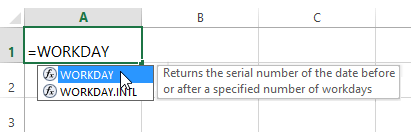
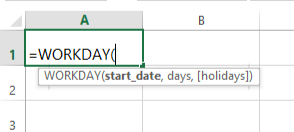
You tin can then type an open up parenthesis to see what kind of arguments it needs.
Understanding nested functions
Whenever a formula contains a function, the function is more often than not calculated before any other operators, like multiplication and division. That'due south because the formula treats the entire part as a unmarried value—before information technology can utilize that value in the formula, it needs to run the function. For example, in the formula beneath, the SUM function will be calculated earlier sectionalisation:
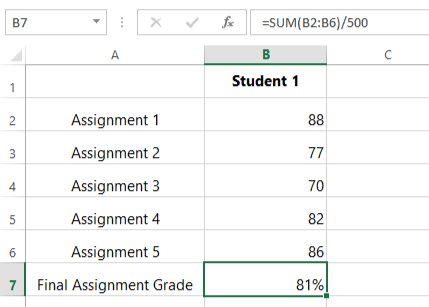
Let'due south take a look at a more complicated case that uses multiple functions:
=WORKDAY(TODAY(),3)
Here, nosotros take two unlike functions working together: the WORKDAY office and the TODAY role. These are known as nested functions, since one function is placed, or nested, within the arguments of another. As a dominion, the nested role is always calculated first, simply like parentheses are performed beginning in the club of operations. In this example, the TODAY function volition be calculated first, since it's nested within the WORKDAY function.
Other common functions
In that location are many other functions yous can use to quickly calculate different things with your information. Learning how to use other functions will allow you to solve complex problems with your spreadsheets, and nosotros'll be talking more virtually them throughout this tutorial. You can also cheque out our articles below to acquire nigh specific functions:
- How to Use Excel'south VLOOKUP Function
- How to Count Cells with COUNTA
- Employ SUMPRODUCT to Calculate Weighted Averages
- CONCATENATE: Excel's Duct Tape
- Utilize the PROPER Function to Capitalize Names in Excel
/en/excelformulas/solving-reallife-issues-in-excel/content/
Source: https://edu.gcfglobal.org/en/excelformulas/functions/1/

Post a Comment for "what are the four parts to every function?"